
Sales Prop vs Retention Prop
What's the point of this post?
Liron Shapira wrote a sanity check for startup ideas which is pretty good, but I wanted to add some more color.
What's the problem?
I've noticed founders use this test, pass it, and then have trouble selling units into market.
What the solution?
To understand that there are two types value props and they confer different benefits.
What are the two value props?
The first is the sales prop. This is the set of benefits you propose your product will provide to the user prior to them ever having used the product. The second is the retention prop. This is the set of benefits you propose your product will provide to the user after they have already used your product.
Why is this distinction useful?
It informs your marketing and pricing decisions. Here are some examples. The late night TV ab machines present the value prop "Spend $x and get better abs.", and it is an empirically effective promise. Statistically it is a lie, but the message resonates with the customer which gets them over the purchase hump, therefore it has a strong sales prop. What happens next is that the customer uses it once and then hides it under the couch for eternity. The customer knows they can pull it out any time and use it, but the proposition in their mind ("feel ab pain now for nice abs in a month") does not resonate so they do not retain. Therefore the retention prop is weak.
Let's take an example of a product that has the opposite situation. Spaced repetition. It passes Liron’s value prop story test because it is evidently very valuable to people trying to memorize a lot, and those that actually use it for an adequate period rave about it, but you simply cannot sell it. Telling people the proposition "This software will help you memorize things way faster", simply does not induce the user to buy it, or even try it. It fails on sales prop but succeeds on retention prop (for those that put in the work).
I get the difference, now what should I learn from it?
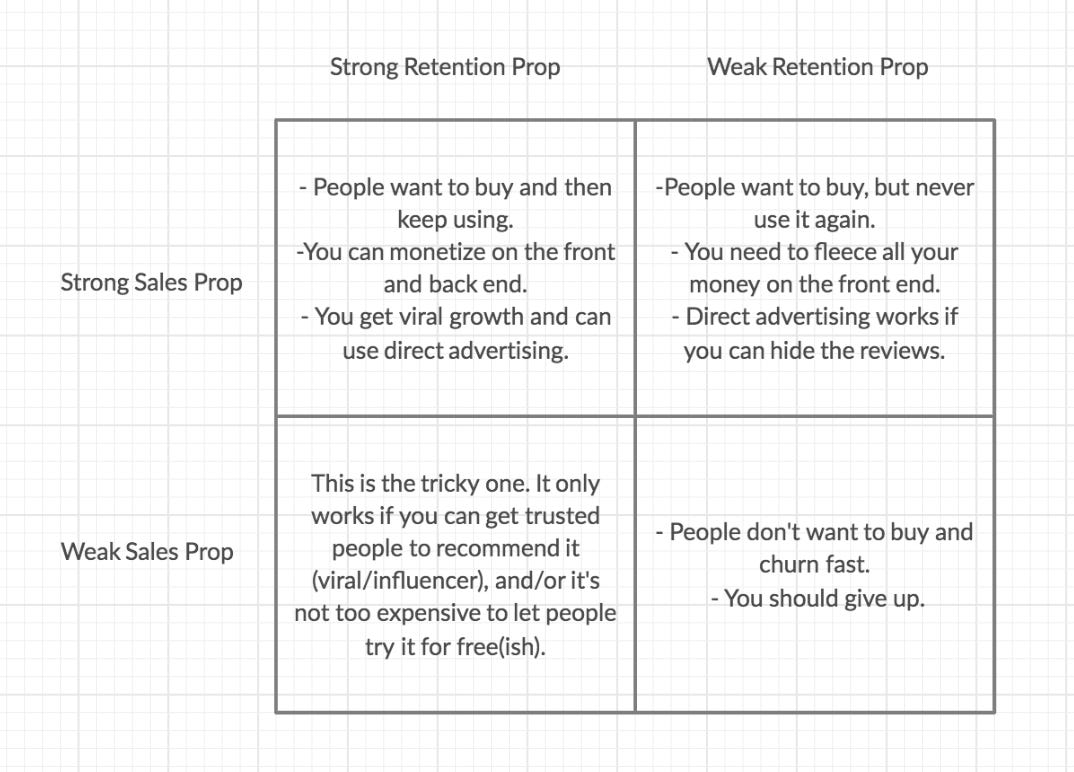
If your product is more appealing to customers before buying it rather than after, like most fads, then you need to charge them up front, and start thinking about how to make money after you've churned your whole market. If your product is more appealing after they have used it, make it as easy as possible for them try it. This means free trials, freemium, saas, and whatever makes the sales prop painless enough to get them over the sales hump, so they can get to the retention prop which is strong.
Oh crap, I sell a physical product which I need to charge for that has a strong retention prop but weak sales prop, what do I do?
The example I like for this is the Oura ring, which is a nerdy health tracking ring. It is expensive gear ($300), and the sales prop they are selling you is not clear. Their sales prop is something like "We help you track your health metrics." To anyone outside the niche biohacking world it's empirically a weak sales proposition, and you just get a confused look when you try to sell it to people. But, if your friend is a user, they convince you to buy it because the retention prop they experience is very strong.
There's a reason why this company doesn't seem to run direct ads, but instead gives the product to influencers (Ben Greenfield, Kevin Rose, Tim Ferriss) to promote it. The sales prop is weak, so they need to rely on your trust in other people to get over the sales hump.
While Oura ring made it work, this is the hardest place to be, because it’s hard to convince people to buy it, and it’s expensive to have people try it. This means your pricing and marketing options are very limited.
What should I take away from this post?
1) It’s important to understand the strength of your sales prop and your retention prop separately.
2) Treat your sales prop and value prop as empirical tests. Ask random people if they would buy x and learn from that, or ask them to use it and see if they retain.
3) Understand that if you have a weak sales prop but a strong retention prop you will need to find a way to get people to use your product, and the most common way is to make it free or cheap to try.